

Photo by BShaffer under CC BY-SA 4.0.
Several folks have asked me what I think of Goldbacks. The short answer is that I really like them! The long answer is more complicated, because the existence of Goldbacks raises some questions.
Let’s define some terms:
- Goldback – shaped like a dollar bill, but containing a thin sheet of gold protected by a clear polymer coating. They come in different denominations, each with an attractive artistic design.
- Instrument – the thing that is handed to a merchant when purchasing goods or services in-person. Could be a coin/bar/bill/note.
- Spot Price – the price at which gold is currently traded, in U.S. dollars.
- Premium – the price above spot, usually expressed as a percentage. If you bought a 1 oz American Gold Eagle coin for $2730 when the spot price was $2600, you would pay a 5% premium. If you bought a 1/1000th oz Goldback for $5.20 when the spot was $2.60 (for 1/1000th of an oz), you would pay a 100% premium.
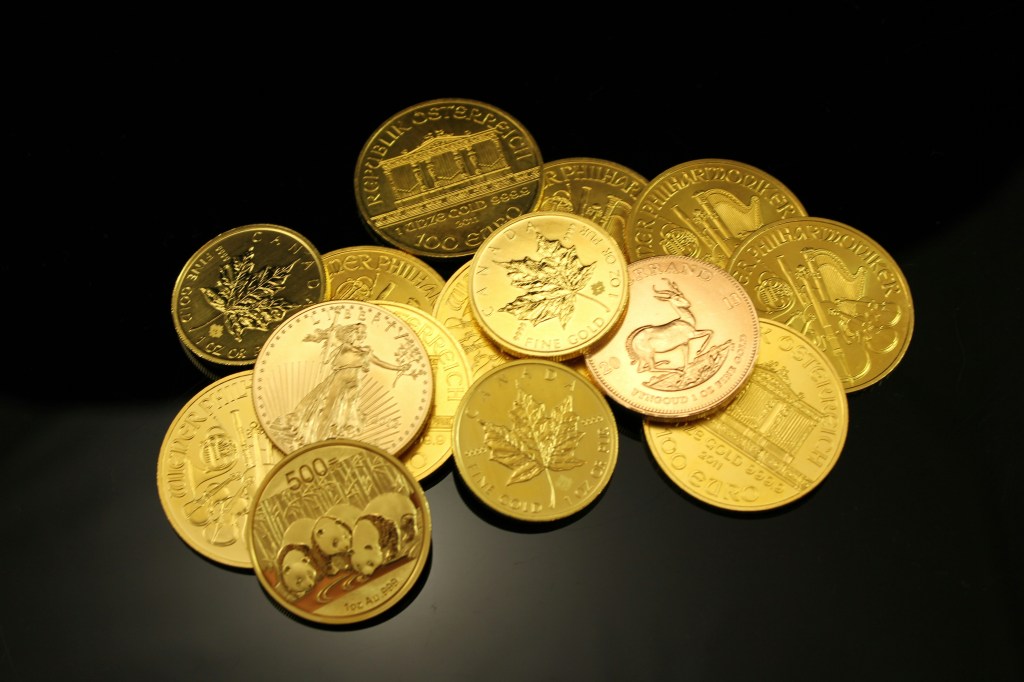
The 1 oz American Gold Eagle is one of the most popular (if not the most popular) gold coins in the world, but the value of 1 oz of gold is around $2600. Smaller coins like the 1/10th oz version are also very popular, but is still around $260 of gold. There is a demand for smaller gold instruments, and the Goldback is an attempt to meet that demand by offering an instrument that contains as little as 1/1000th of an oz of gold, worth about $2.60. This is great news for those of us who see gold as the best currency, but the 100% premium leaves many of us wondering if something better may someday be brought forth.
Some are suggesting that pure gold is not necessary, a low-gold alloy would work. Others are suggesting silver coins can better fill the need for smaller amounts, and that small gold instruments are not needed at all.
Unfortunately, we have to begin at the beginning – priorities.
Priorities
Just what exactly are we shooting for? The below list is my attempt to state which things I believe are more important than others, with #1 being highest priority.
- Supports a monometallic system where gold and only gold is the currency. Bimetallic (and trimetallic) systems have caused many problems in the past. Gold has been chosen by the free market as the primary definer of money, the premier currency, the ultimate means of payment. Everything else is subpar. Silver is probably 2nd best, but if you look at a chart of silver priced in gold, you see that silver doesn’t hold its value over time. If you pay someone in silver, you are conferring an obligation upon them – to fairly quickly convert it into something that doesn’t lose value.
- Note – I do not consider gold to be an investment. Investments have the potential to grow but they involve risk. Gold is one of the few non-risk assets that holds its value over time, and when you look at other factors such as divisibility and portability, gold becomes the single best currency.
- The gold is in the instrument. When you hand somebody the instrument, you are handing them gold, not some representative symbol or token. This prevents the possibility of government debasement, and is a key to preventing tyranny.
- Low premium – we want low premium, but the quest for low premium should not be the highest priority. Imagine 2 scenarios:
- Scenario A: Priorities #1 and #2 are in place, but the premium is 100%.
- Scenario B: Premium is less than 1%, but either Priority #1 or #2 is not upheld.
- I would choose A over B every day of the week.
- Durability – This is closely related to premium, because if an instrument doesn’t last long and needs to be replaced, the pain from the premium is amplified. A 22-karat gold coin is about twice as hard as a 24-karat gold coin, so perhaps it lasts twice as long on average before it has to be turned in to be melted down and restruck? In that case I wouldn’t mind if the premium of a 22-karat gold coin was 10% or 20% higher – it could be 99% higher and it would still be preferable. Durability also includes a high melting point, good corrosion resistance, etc.
- Good security/anti-counterfeiting features.
- Size/Weight – How painful is it to carry around? How much space does it take up when storing? The Romans used large cast bronze ingots weighing up to 5.5 lbs before eventually switching to coins made of metals more precious than bronze. I also don’t want a coin that is too small, and a pure gold coin weighing 1/1000th of an oz would be too small.
- Nondestructively testable – How do we know how much gold an instrument has in it? Being nondestructively testable is preferable, but destructive testing of random samples is always possible, though more expensive. Notice a destructive test would only destroy the premium, not the gold.
- Color – This is near the bottom because I just don’t care if it looks golden or not. I’ve always thought the penny was ugly, but I still jump for joy when I find one on the ground.
- Misc – it should have the year on it (i.e. be a coin not a round), be in troy ounces (not grams), have In God We Trust or something similar, not have any pagan goddesses, not have a serial number, etc.
Once we have an instrument that maximally satisfies these priorities, we want a banking/payment system built on top of it. A banking/payment system can be built on existing gold coins like the American Gold Eagle series coins, but having smaller denominations would allow for greater flexibility when depositing/withdrawing. I wouldn’t want folks to be overly reliant on the banking/payment system, they should be ready and able to pay for goods and services with physical coins in case the Internet or power grid is down for an extended period. I’ve also heard that paying with physical money reduces impulse purchases, and some find it easier to stick to a budget (“cash stuffing”).
Brainstorming an alternative
Despite the high premium, Goldbacks score quite well on my priority list because #1 and #2 are upheld. But could there exist a dime-sized coin with 1/1000th of an oz of gold in it? What would its premium be?
The Japanese have been producing an alloy called Shakudō since the 12th century. It contains 4–10% gold and 96–90% copper, so we know a low-gold alloy is possible. However, a dime-sized coin with 1/1000th of an oz of gold would contain about 0.636% gold and 99.364% copper (calculations are below). It may be difficult to get an alloy with that precision.
I’ve become fascinated with clad coins because all quarters, dimes, and pennies minted today are clad. A clad coin is a coin made of multiple layers of metal, with an inner (middle) layer of one metal and outer (top and bottom) layers of a different metal, sandwiched together during rolling. Imagine if gold was on the inside (middle layer), and copper on the outside (top and bottom layers) – this would result in the gold being protected by the cheap copper, so the coin could wear down over long periods of handling without losing any of the gold – an increase in durability. If the gold layer is too soft or too thin for this (I would assume “yes” to both), then perhaps it could be alloyed prior to cladding. In other words, an inner layer of low-gold copper alloy clad with an outer layer of pure copper. This should allow the inner layer to be thick and hard enough to decrease periodical necking, meandering, and fracture during rolling.
What would the premium be for a dime-sized coin with 1/1000th of an oz of gold alloyed and clad with copper? I’m going to take a stab at this even though I’m no metallurgist – in fact a real metallurgist might chuckle at some of my methods below. But hopefully they will add a comment during or after the chuckling so the rest of us can get in on the joke. The U.S. Mint tells us the Total Unit cost of producing and distributing a dime, but what we need is the Total Unit cost minus the cost of the metals, so we’ll have to do some math.
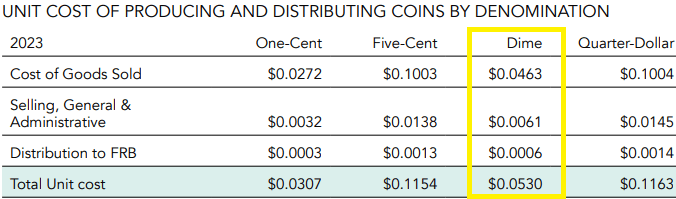
Notice the cost to distribute a dime is twice the cost to distribute a penny even though a dime is smaller and weighs less. This probably has to do with increased insurance and security costs, and possibly the use of smaller bags since a dime is more easily bent, so more trips with the forklift, less efficient use of the armored truck, etc.
I estimate the costs of the metals in a dime to be $0.021787 (calculations are below). So the Total Unit cost ($0.0530) minus the cost of the metals ($0.021787) is $0.031213.
If we add 1/1000th of an oz of gold into a dime, we can probably expect the Total Unit cost minus the cost of the metals to double or even triple. This is because of the additional costs of financing the gold, transporting the gold, securely storing the gold, alloying/cladding the gold into the coil for blanks, and the distribution costs would go up as well (for the reasons mentioned above).
So let’s assume the worst: $0.031213 * 3 = $0.093639. Now we need to add in the cost of the copper for our new dime, which I estimate to be $0.019219, so the total becomes $0.112858. This is the cost of everything it would take to produce our new dime-sized coin minus the cost of the gold itself, which is exactly what we need in order to calculate premium. Assuming the spot price of gold is $1943 per oz (we have to use 2023 numbers to match the data from the U.S. Mint), the premium would be $0.112858 / $1.943 = 5.8084%.
5.8% is a low premium, but it does have some caveats:
- This is the unit cost from the mint’s perspective, but they wouldn’t do this unless they could profit, so expect the buyer to have to pay something like 25% more, so around 7.25%.
- This is wholesale premium, not retail premium, so for an individual wanting to purchase these one at a time, you can expect the premium to double, so around 14.5%.
- This assumes the production volume is on par with the current dime, which is 2.7 billion units per year. If a new coin like this were to be introduced, the premium would start out higher, then gradually come down as popularity goes up.
This premium is low enough that it could be absorbed by the company ordering the coins from the mint, so that the market value of the coin would match the market value of the gold in the coin. If the face value showed the weight of the gold in the coin (1 GT), everything would work out nicely. Who might be interested in absorbing the premium? Perhaps the company that provides the banking/payment system.
Supporting calculations
- Spot price of copper (2023 average): $3.8662 per lb = $0.0085235 per g
- Spot price of nickel (2023 average): $21,521.12 per metric ton = $0.021521 per g
- Spot price of gold (2023 average): $1943.00 per troy oz = $62.4689 per g
Costs of the metals in old dime:
- Copper: 2.268 g * 91.67% * $0.0085235 per g = $0.017721
- Nickel: 2.268 g * 8.33% * $0.021521 per g = $0.0040658
- Total: $0.017721 + $0.0040658 = $0.021787
Cost of copper for our new dime:
- Density of copper: 8.96 g/cm3
- Density of nickel: 8.90 g/cm3
- Density of gold: 19.32 g/cm3
- Volume of copper in old dime: 2.268 g * 91.67% / 8.96 g/cm3 = 0.23204 cm3
- Volume of nickel in old dime: 2.268 g * 8.33% / 8.90 g/cm3 = 0.021227 cm3
- Total volume of metals in old dime: 0.23204 cm3 + 0.021227 cm3 = 0.253267 cm3
- Volume of 1/1000th of a troy oz of gold: 0.0311035 g / 19.32 g/cm3 = 0.0016099 cm3
- Volume of copper in new dime: 0.253267 cm3 – 0.0016099 cm3 = 0.2516571 cm3
- % copper in new dime: 0.2516571 cm3 / 0.253267 cm3 = 99.364%
- Weight of copper in new dime: 0.2516571 cm3 * 8.96 g/cm3 = 2.2548 g
- Cost of copper in new dime: 2.2548 g * $0.0085235 per g = $0.019219
 Smithmont Blog
Leave a comment